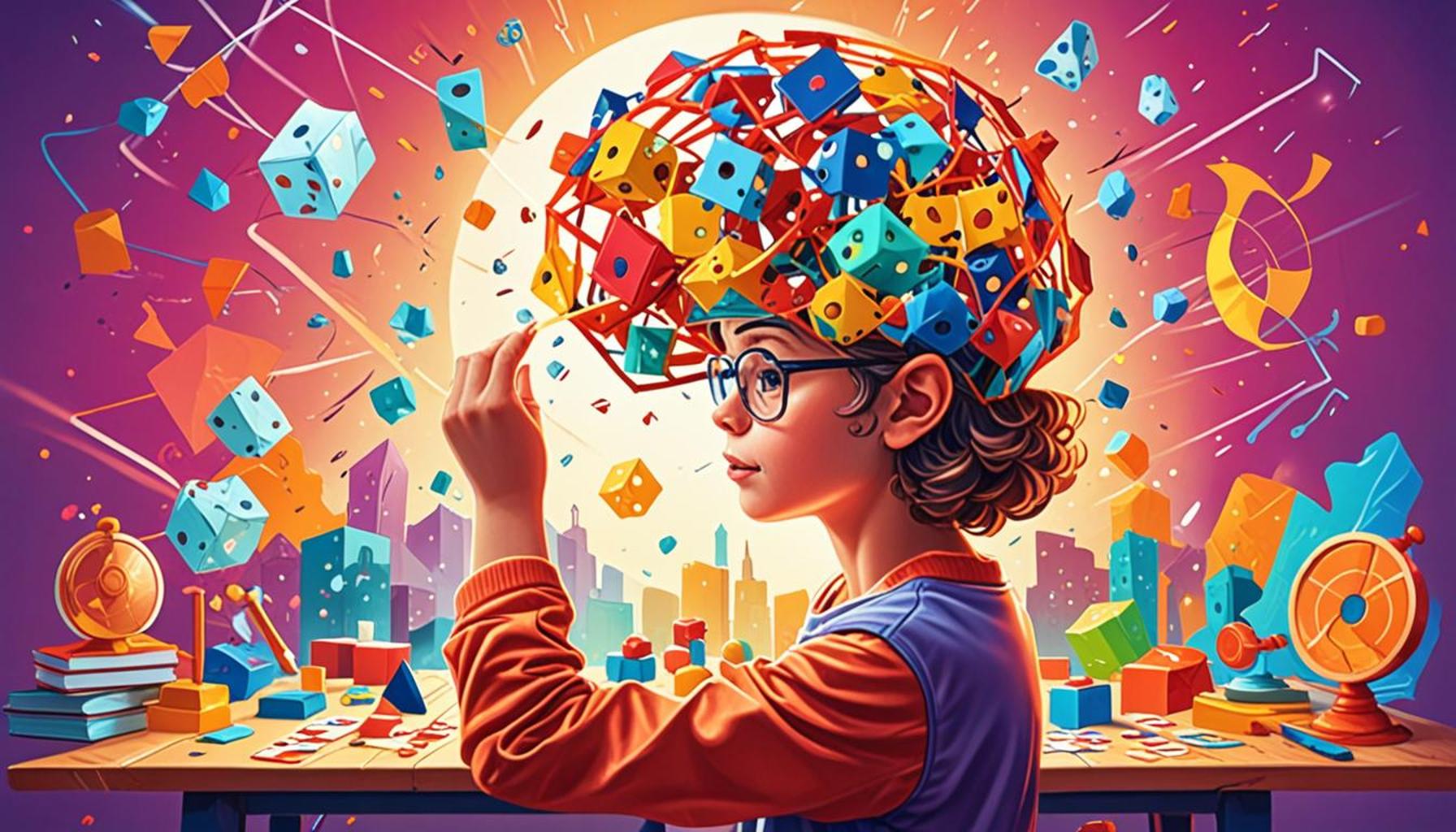
Mathematical Challenges: The Connection between Number Games and Cognitive Skills

The Cognitive Benefits of Number Games
Mathematics transcends mere equations and formulas, unveiling a rich landscape of cognitive challenges that can significantly enhance our mental capabilities. Particularly in Nigeria, where the education system is rapidly evolving and becoming more competitive, understanding the correlative link between number games and cognitive skills is crucial for both students and educators alike. These games pave the way for improved critical thinking and intellectual growth, making them an invaluable resource for cognitive development.
Engaging with number games provides a fun yet challenging avenue to boost various cognitive abilities, which are essential for academic success and everyday problem-solving. Take a look at some of the key skills enhanced by regular participation in these mentally stimulating activities:
- Problem-solving skills: Working through mathematical puzzles helps cultivate critical thinking skills necessary in both academic settings and real-life situations. For instance, a student tackling a complex Sudoku puzzle hones their ability to approach problems logically and develop systematic strategies for finding solutions.
- Memory retention: Regular interaction with number games serves to enhance memory, both short-term and long-term. Studies suggest that individuals who engage in memory-intensive games demonstrate improvements in their ability to recall information, which is particularly beneficial for students learning new concepts or preparing for exams.
- Analytical skills: Many number games require players to analyze patterns and predict outcomes. Games like chess or dame (draft) encourage players to consider multiple possibilities and make strategic decisions based on logical reasoning.
In Nigeria, the vibrant culture of competitive traditional games such as draft and owari beautifully merges entertainment with cognitive enhancement. Playing olokun (another name for owari) not only entertains but also sharpens numerical skills, as players calculate scores and adjust strategies in real-time. These games not only hold cultural significance but also serve as an accessible way for learners to build essential cognitive skills.
Research continues to affirm the connection between engaging with mathematical challenges and enhanced cognitive development. For instance, a study conducted at the University of Lagos found that students who regularly participated in analytical games improved their performance in mathematics classes. By integrating these games into an educational framework, teachers can create more dynamic and interactive learning environments.
Join us in unveiling the myriad ways in which engaging in mathematical challenges—both traditional and modern—can transform the learning experience and bolster cognitive development for students across Nigeria. These number games are not merely pastimes; they are gateways to improved reasoning, efficient problem-solving, and a foundational love for mathematics that could elevate a nation’s educational standards.
SEE ALSO: Click here to read another article
Unlocking Cognitive Potential Through Number Games
In an increasingly digital world, where traditional learning methods often take a backseat, the role of number games in developing cognitive skills cannot be overstated. These games create an interactive platform where entertainment and education intersect, enabling learners to refine essential skills while engaging in playful competition. In Nigeria, where the quest for academic excellence and cognitive development is paramount, embracing these numerical challenges may hold the key to fostering a generation of innovative thinkers.
One leading advantage of incorporating number games into daily routines is their ability to nurture critical thinking, which is foundational to succeeding in any academic pursuit. For instance, games such as Ludo or Monopoly require players to strategize, make decisions based on calculated risks, and consider the implications of their moves—skills that directly translate to better problem-solving abilities. Moreover, each game played can introduce different mathematical concepts, from addition and subtraction to more complex operations like multiplication and division, seamlessly integrating math into everyday life.
Another significant advantage is the enhancement of visual-spatial skills. In games like Tetris, players must analyze shapes and predict how pieces will fit together, promoting spatial awareness and visual processing abilities. This skill set is incredibly valuable in various fields, including engineering, architecture, and computer science, where understanding shapes and dimensions is crucial. As Nigerian students navigate diverse educational paths, sharpening these skills through engaging activities can set them apart in their respective domains.
- Enhancing logical reasoning: Number games often require players to employ deductive reasoning to arrive at conclusions. Engaging in games such as Sudoku compels players to use logic to determine the proper placement of numbers, thereby reinforcing critical reasoning skills.
- Boosting concentration: Many number games necessitate sustained focus and concentration, helping players develop the discipline needed to maintain attention over extended periods. This focus is essential in the classroom, where distractions abound.
- Fostering teamwork and social skills: Collaborative number games not only enhance mathematical proficiency but also encourage teamwork. Participating in group-oriented activities like team-based quizzes or math competitions promotes communication, cooperation, and interpersonal skills vital for future success.
As the landscape of education in Nigeria continues to evolve, it is essential for educators and parents to recognize and harness the potential of number games in fostering cognitive development. The immersive nature of these games captivates learners and encourages a deeper engagement with mathematical concepts, transforming them from mere numbers into tools for critical thought and creativity.
Emphasizing a curriculum that integrates these engaging mathematical challenges could cultivate an environment where students not only learn but thrive, unlocking their full cognitive potential.
| Category | Description |
|---|---|
| Enhanced Problem Solving | Engaging in number games promotes critical thinking, encouraging individuals to approach challenges with innovative solutions. |
| Improved Memory Retention | Playing mathematical games helps develop working memory, allowing for better recall of numbers and patterns essential in daily tasks. |
Exploring the depths of the relationship between number games and cognitive skills reveals a treasure trove of insights. Through engaging in mathematical challenges, individuals often find themselves refining skills that are not only integral to academic success but also applicable to everyday life. For instance, enhancing problem-solving capabilities through games can lead to improved decision-making processes in various situations, from personal financial management to professional environments.Moreover, the link between gaming and memory retention cannot be underestimated. When players immerse themselves in complex numerical scenarios, they exercise their brains, resulting in better cognitive flexibility. Such cognitive benefits are instrumental in achieving long-term academic excellence, making number games an invaluable resource in educational settings.As we delve deeper into mathematical challenges, it becomes essential to recognize the broader implications of developing robust cognitive skills through interactive learning, driving interest and promoting a culture of analytical thinking.
LEARN MORE: This related article may interest you
The Experiential Learning that Number Games Facilitate
Number games play a significant role in experiential learning, allowing individuals, especially students, to discover mathematical concepts through experience rather than traditional instruction. This approach is vital in Nigeria, where educational structures often lean toward rote memorization rather than critical application of knowledge. Games like math Bingo or number puzzles challenge participants to think critically, enhancing their understanding of numeracy while allowing them to engage with peers, thereby fostering a robust learning community.
Consider the logical framework established by games such as Chess. Although traditionally seen as a strategy game, chess incorporates fundamental mathematical concepts such as counting, patterns, and probabilities, laying a groundwork for analytical skills. Nigerian youth can benefit from engaging in chess clubs or competitive tournaments that serve as platforms not only for enhancing cognitive skills but also for building a sense of community. Collaborative gameplay promotes healthy competition and personal growth, as players learn to anticipate opponents’ moves based on strategic number placements.
The principle of gamification in education is further underscored by cognitive science research, which indicates that learners who participate in game-based activities are more likely to retain information and express enjoyment towards learning. Beyond just a source of amusement, number games function as potent tools for knowledge retention and application. For example, students practicing flashcards for multiplication tables may find their recall abilities sharpened, which translates to improved performance in exams.
- Promoting adaptive thinking: Proficiency in number games helps students develop adaptive thinking—a critical skill in today’s fast-paced environment. By engaging with games like Math Jeopardy, learners face unexpected challenges that require swift mathematical reasoning, thereby enhancing their adaptability to new situations.
- Improving memory skills: Number games often involve memorization and recall, promoting better memory skills that are crucial for academic success. As learners navigate through the challenges of games like number memory match, their capacity to store and retrieve numerical information is significantly improved.
- Expanding divergent thinking: Number games encourage divergent thinking, where players explore multiple solutions to a problem. Participating in games such as math-based escape rooms challenges players to think outside the box, fostering creativity in their approach to finding solutions.
Moreover, the potential for adaptive technologies to enhance the experience of number games is expanding. With the surge in mobile applications that incorporate gamified math learning experiences, such as Kahoot! or Prodigy, Nigerian students can access engaging, interactive platforms catering to their learning needs anytime and anywhere. This flexibility is essential in democratizing access to quality education and ensuring equal opportunities for all students, regardless of geographic or socioeconomic constraints.
In this rapidly changing landscape, fostering an environment that prioritizes mathematical challenges through number games not only enriches students’ educational experiences but also equips them with essential life skills. This seamless integration of play and learning may indeed be the touchpoint that nurtures a brighter future for Nigeria’s emerging innovators and problem-solvers.
YOU MAY ALSO LIKE: Read read another article
Conclusion: Embracing the Power of Number Games in Cognitive Development
In an era where critical thinking and adaptability are paramount, the role of number games in enhancing cognitive skills cannot be overstated. This article has explored how these engaging activities not only provide a platform for experiential learning but also facilitate an environment that nurtures mathematical understanding and critical thought. From the strategic complexities of games like chess to the enjoyable challenges posed by math Bingo, students in Nigeria can significantly benefit from the multifaceted skills these games cultivate.
As we delve deeper into the impact of gamification, it becomes evident that students are more likely to retain knowledge while developing essential life skills through playful learning approaches. The ability to adapt to new challenges, improve memory retention, and expand creative problem-solving abilities underscores the profound connection between playful number games and cognitive skill enhancement.
This unique fusion of play and education offers a promising avenue for not only improving academic performance but also for preparing a generation of agile thinkers capable of navigating complex real-world challenges. Furthermore, the rise of interactive applications like Kahoot! and Prodigy ensures that access to these beneficial experiences is more widely available than ever, empowering every student, regardless of background, to thrive in a competitive landscape.
To harness the full potential of learning through number games, educators, parents, and policy-makers must prioritize this innovative approach. By embracing the power of mathematical challenges, we can pave the way for Nigeria’s future innovators and problem-solvers to emerge, ultimately fostering a community that values critical thinking and creativity in education.